¶ Contacts Module
¶ Overview
In the Contact Center edition, the Contacts Module is configured and managed per system setup.
PBXware version 8 enhances the existing Contacts Module, standardizing contact management across the system and enabling advanced Contact Center capabilities.
The Contacts Module provides centralized contact management across PBXware and gloCOM applications, with role-based permissions and structured visibility control at system level.
The module is designed to:
- Eliminate duplicate contact lists across the system
- Improve visibility across departments
- Respect user permissions and privacy
- Enable consistent contact usage across voice, chat, SMS, and email channels
- Provide cross-channel conversation history (Contact Center feature)
¶ Contact Types
Within the system, PBXware supports three types of contacts:
¶ Global Contacts
- Visible to all users within the system
- Intended for shared customers, partners, and vendors
¶ Department Contacts
- Visible only to users who belong to the selected department(s)
- Must belong to at least one department
¶ Private Contacts
- Visible only to the contact owner
- Used for personal or restricted contact information
Each contact displays:
- Contact type (Global / Department / Private)
- Contact owner (for Private contacts)
¶ User Roles and Permission Scope (Per System)
Permissions depend on the user role within the system.
¶ System Administrator
Has full system-wide access.
Can:
- View, search, add, edit, delete all Global contacts
- View, search, add, edit, delete all Department contacts
- View, search, add, edit, delete all Private contacts
- Convert contacts between Global, Department, and Private
- Upload and download CSV files
- Download CSV templates
- View uploaded files
- Assign Private contacts to any extension
- Assign contacts to any department
Conversation history:
- Fully available (Contact Center feature)
¶ Department Administrator
Automatically becomes administrator for all departments the extension belongs to.
Scope is limited to their departments.
Global Contacts:
- View and search Global contacts
- Add Global contacts
- Edit Global contacts
- Delete Global contacts
- Upload and download Global contacts via CSV
- View uploaded files
Department Contacts:
- View contacts from their departments
- Add contacts to their departments
- Edit contacts from their departments
- Delete contacts from their departments
- Upload department contacts via CSV (for their departments)
Private Contacts:
- View private contacts only if they are the contact owner
- Add private contacts for themselves
- Edit their own private contacts
- Delete their own private contacts
Conversion rights:
- Convert Global contacts to:
- Their departments
- Their own private contacts
- Convert Department contacts within their departments
- Cannot convert contacts outside their departments
Conversation history:
- Available for contacts within their departments
¶ Department User
Scope limited to ownership and department membership.
Global Contacts:
- View and search Global contacts
- Add Global contacts
- Edit Global contacts
- Cannot delete Global contacts
Department Contacts:
- View contacts from their departments
- Add contacts to their departments
- Edit contacts from their departments
- Cannot delete Department contacts unless they are the contact owner (if applicable)
Private Contacts:
- View only their own private contacts
- Add their own private contacts
- Edit their own private contacts
- Delete their own private contacts
Conversion rights:
- Can convert contacts only if they are the contact owner
- Can convert:
- Their private contacts to Global
- Their private contacts to their departments
- Their department contacts (if owner) within allowed scope
CSV permissions:
- Cannot upload CSV files
- Cannot download CSV files
- Cannot view uploaded files
Conversation history:
- Available for contacts they have permission to access
¶ Deskphone User
- Can view Global contacts
- Cannot add, edit, delete, convert, or upload contacts
¶ Contacts in PBXware GUI (Per System)
The Contacts Module in PBXware allows system-level contact management:
- Contact list view with filtering
- Smart CSV import (merges duplicates, preserves existing data)
- CSV export
- Contact visibility selection (Global / Department / Private)
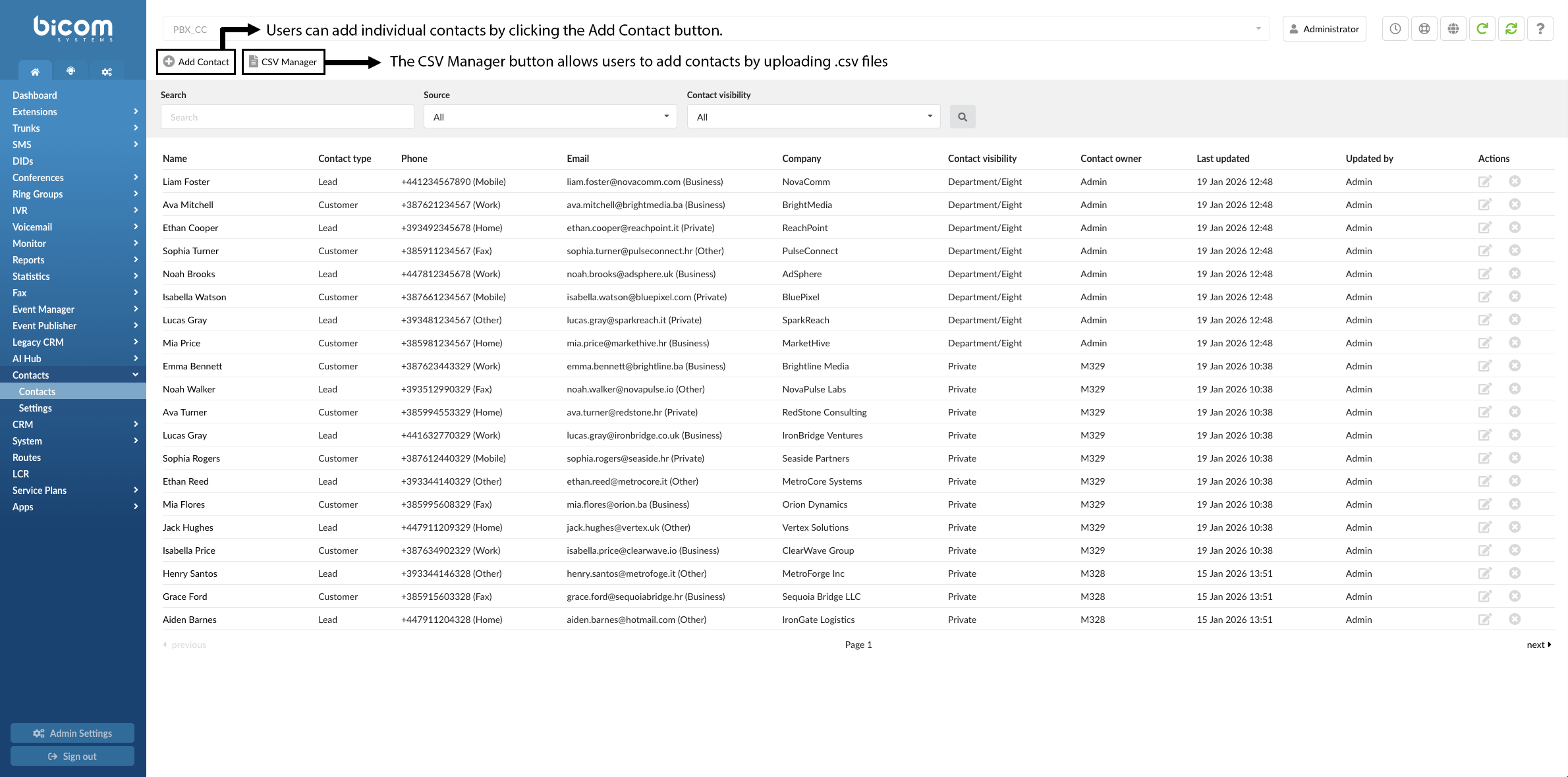
Contacts synchronized from Microsoft 365 or third-party integrations:
- Are created as Global contacts
- Are read-only
- Cannot be edited, deleted, or merged
¶ Adding Contacts
Contacts can be added individually or in bulk within the system.
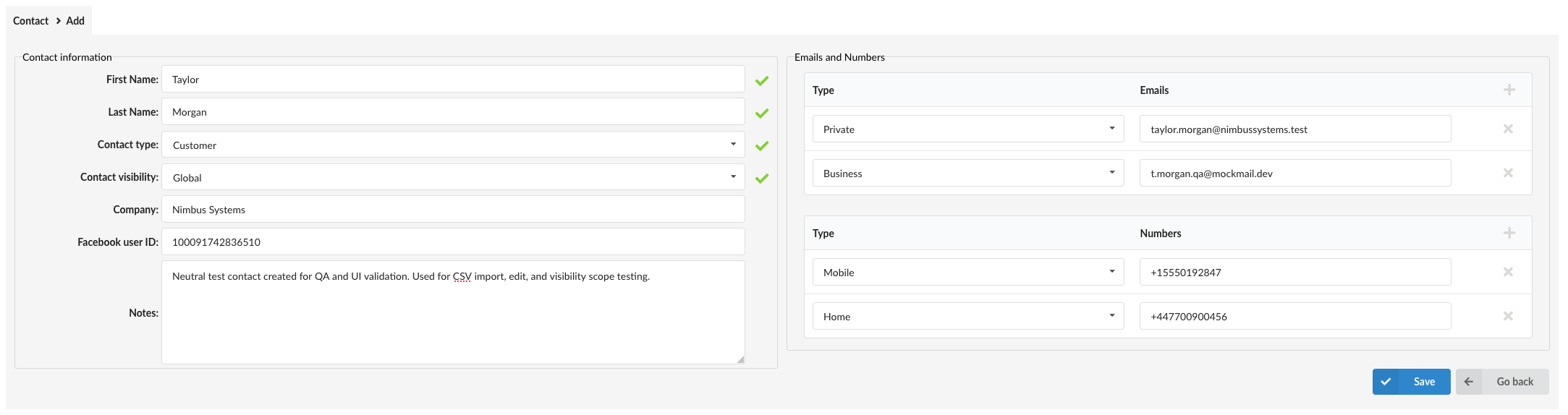
¶ Adding an Individual Contact
- Navigate to Contacts → Add Contact.
- Enter required information.
- Select Contact Visibility:
- Global (visible system-wide)
- Private (assigned to a specific extension)
- Department (assigned to selected department(s))
- Click Save.
¶ Adding Contacts via CSV Manager (Bulk Import)
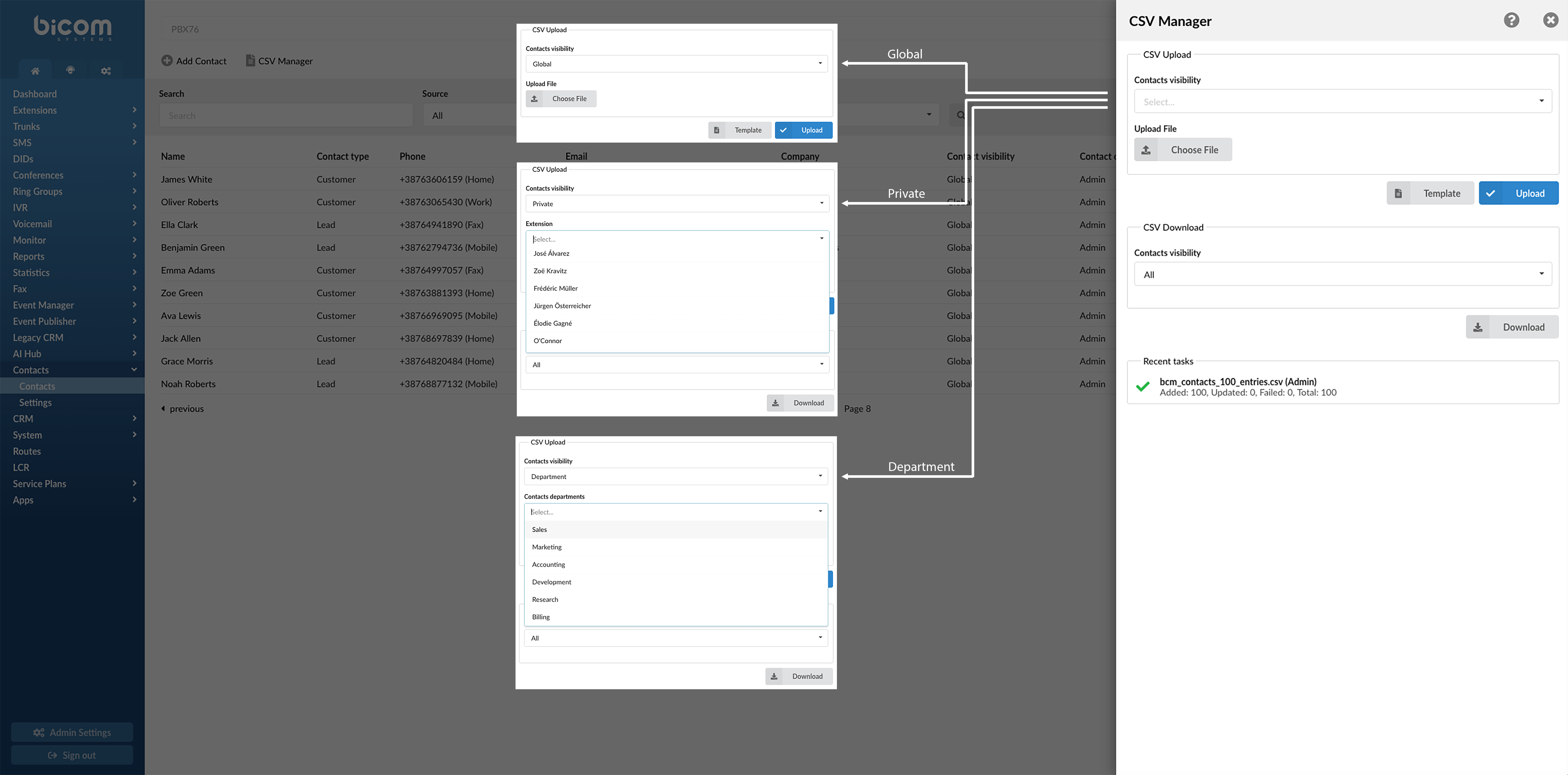
- Navigate to Contacts → CSV Manager.
- Select Contact Visibility:
- Global
- Private (select extension owner)
- Department (select department(s))
- Click Template to download the CSV format reference.
- Click Choose File and select your
.csv. - Click Upload.
Smart Import Behavior:
- Existing contacts are preserved
- Duplicates are merged
- New entries are added
¶ Viewing Import Job Details (8.1)
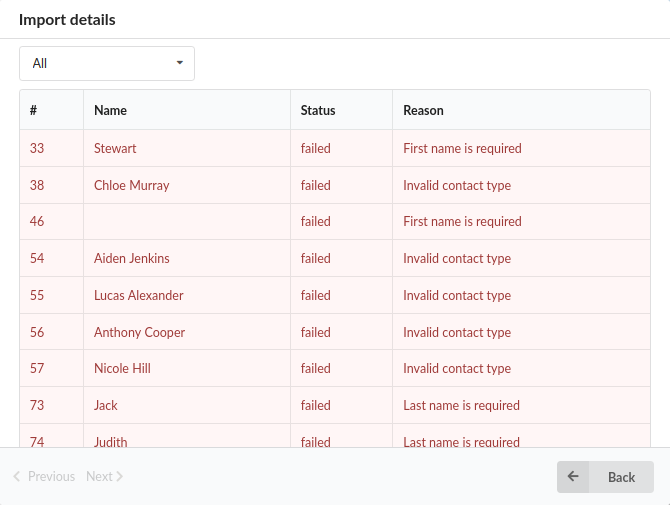
After a CSV import job completes, a Details button appears next to the job in the import history list. Clicking it opens the Import details modal with a list of contacts that failed to import and the reason for each failure.
The modal displays a table with the following columns:
- # — Row number from the CSV file
- Name — Contact name as it appeared in the CSV
- Status — Import result for that contact (e.g.
failed) - Reason — Specific reason for failure (e.g.
First name is required,Invalid contact type,Last name is required)
Results can be filtered using the dropdown at the top of the modal. Use Previous and Next to navigate between pages of results.
¶ CSV File Format
When preparing a CSV file for import, the file must follow the required column structure.
¶ Required Header Row
name,last_name,company,contact_type,phone,phone_label,email,email_label,fbUserId,notes
¶ Example CSV File
INFO
Below is a valid example of a properly formatted CSV file for contact import:name,last_name,company,contact_type,phone,phone_label,email,email_label,fbUserId,notes Noah,Bianchi,PulseNet,customer,+14085550101,home,noah.bianchi@pulsenet.com,private,222000000000,Needs pricing clarification. Liam,White,CommStack,lead,+13105550102,work,liam.white@commstack.com,private,222000000001,Requested SLA information. Emma,Schmidt,RingLogic,customer,+12125550103,mobile,emma.schmidt@ringlogic.com,business,222000000002,Considering long-term contract. Lucas,Anderson,NetPulse,customer,+17185550104,home,lucas.anderson@netpulse.com,business,222000000003,Needs pricing clarification. Emma,Baker,DataRoute,lead,+16175550105,other,emma.baker@dataroute.com,other,222000000004,Requested SLA information.
¶ Field Description
- name – Contact first name
- last_name – Contact last name
- company – Company name
- contact_type – Must be
customerorlead - phone – Phone number in international format (E.164), starting with
+ - phone_label – Example values:
home,work,mobile,other - email – Email address
- email_label – Example values:
private,business,other - fbUserId – Facebook User ID (optional)
- notes – Additional contact notes (optional)
¶ Important Notes
- The first row must contain the header.
- Phone numbers must be in international format (e.g.,
+14085550101). - Do not remove or rename columns.
- Additional columns are not supported.
- Empty values are allowed where applicable.
¶ Exporting Contacts via CSV
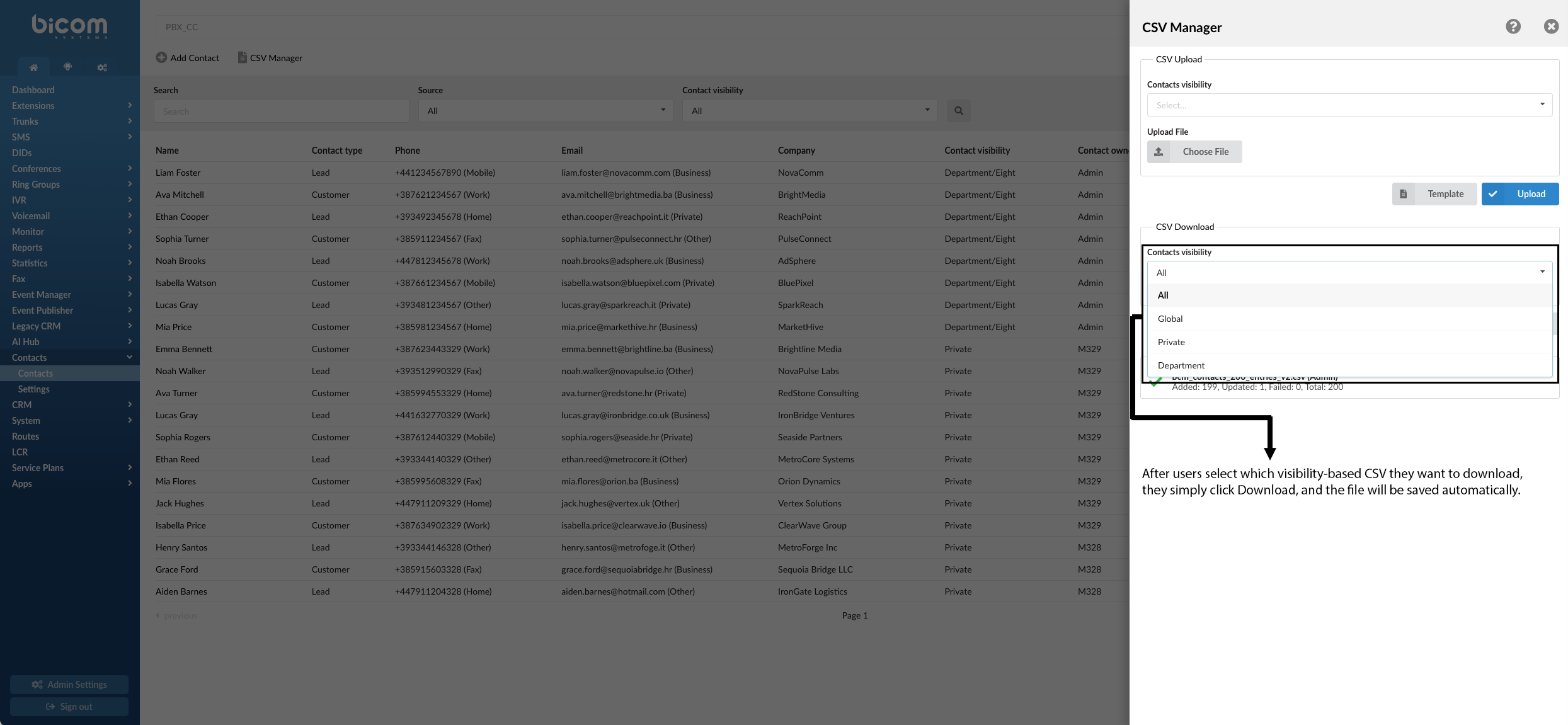
- Select contact visibility scope:
- Global
- Private (per extension)
- Department
- Click Download.
¶ Personal Phone Book (Deprecated)
The Personal Phone Book in OSC (Online Self Care) is being deprecated.
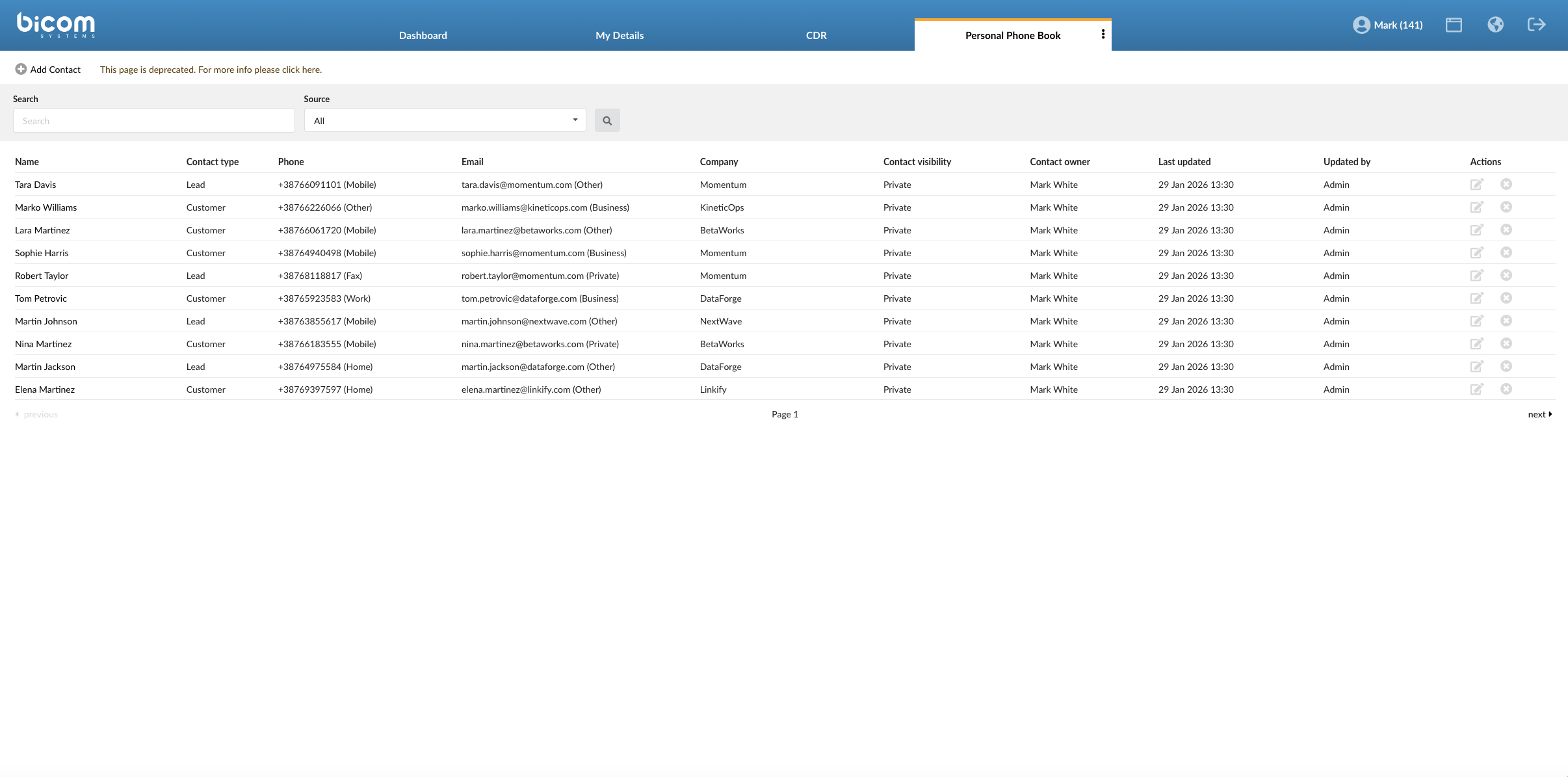
It is still available in the current version, but provides limited functionality.
Currently, OSC provides access only to the logged-in user’s Private contacts and offers limited contact management functionality.
Users can:
- View a list of their own Private contacts
- Add new Private contacts
- Edit their own Private contacts
- Delete their own Private contacts
The Personal Phone Book in OSC does not support:
- Global contacts
- Department contacts
- CSV import or export
- Contact conversion between types
- Advanced visibility or permission management
All advanced contact management functionality is centralized in the Contacts Module and gloCOM applications.
¶ Contacts in gloCOM Applications
The Contacts Module is available in:
- gloCOM Web
- gloCOM Desktop
- gloCOM Go
Permissions in gloCOM follow the same role-based structure described above and are enforced system-wide.
¶ Contacts in Calls and Conversations
¶ Active Conversations
- Contact name is displayed if linked
- Permissions are not enforced in active conversation view
- Most recently updated contact is displayed if multiple matches exist
¶ Closed Conversations
- Contact information reflects data at time of conversation completion
- Permissions do not affect visibility
¶ Conversation History
- Fully available in Contact Center edition
- Accessible based on user role and department scope
¶ Settings
The Contacts feature allows PBXware systems to synchronize and manage external contact sources such as Microsoft 365 and a Custom Contacts application. It is designed to help users easily manage their contacts—add new ones, update existing entries, and delete contacts—by integrating external directories directly into PBXware. Users can configure and manage contact sources through the PBXware GUI under the Contacts → Settings page, with options for manual and automatic synchronization. This ensures a streamlined contact management experience without needing to switch between systems. The feature is designed as a one-way sync, meaning external sources populate PBXware, but changes made locally are not pushed back to the external source.
NOTE: All synced contacts will be displayed in the gloCOM Central Phone Book and in the Contacts section of the Agent application. These contacts can be edited or deleted from the Agent interface, but such changes will not affect the original external source and will not be overwritten in the Agent panel after the next sync.
¶ Contact Source Settings (Microsoft 365 & Custom)
PBXware provides administrators with the ability to configure synchronization settings for external contact sources. These settings are accessible under Contacts → Settings, where two tabs are available: Microsoft 365 and Custom.
¶ Microsoft 365 Contacts Settings
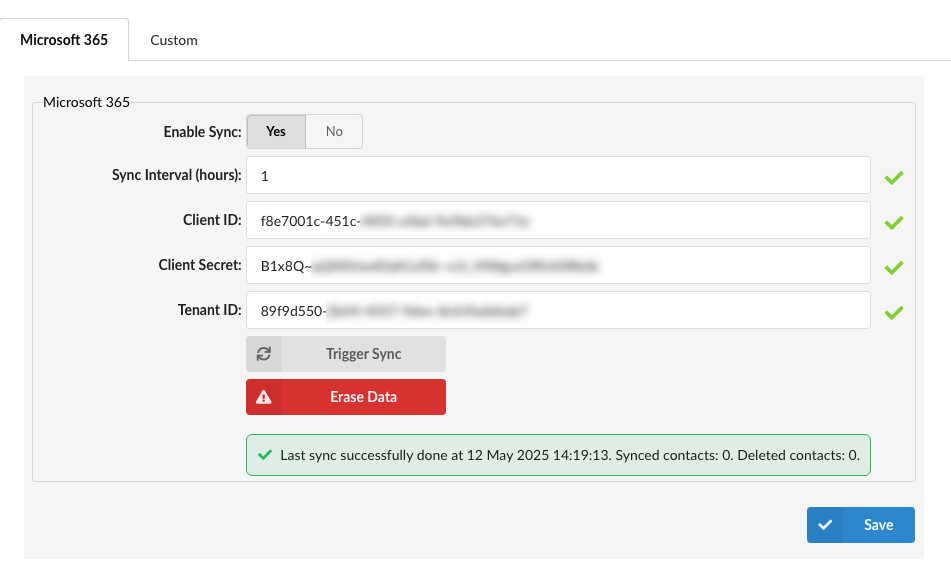
The Microsoft 365 tab allows administrators to integrate PBXware with an Azure/Microsoft tenant and set up contact synchronization. The following fields and options are available:
-
Enable Sync: This toggle controls whether automatic synchronization with the external contact source is active.
-
If set to No, the configuration will be saved, but no synchronization will occur regardless of the value set in Sync Interval (hours). In this case, contacts will not be synced until the user manually triggers the sync by clicking the Trigger Sync button.
-
If set to Yes from the beginning, the system will immediately perform a full synchronization of all contacts from the external source, and continue to sync them periodically based on the interval defined in Sync Interval (hours).
-
The default value for Sync Interval is 24 hours, meaning the sync will run once every 24 hours unless changed by the administrator.
-
After the initial full sync, all subsequent sync operations will only process newly added, edited, or deleted contacts, ensuring efficient updates without reimporting all data.
This setting gives users control over whether syncing begins immediately or remains inactive until explicitly triggered.
-
-
Sync Interval (hours): Defines how often automatic synchronization will occur when sync is enabled.
-
Client ID: Azure application client ID.
-
Client Secret: Secret key associated with the client ID.
-
Tenant ID: Microsoft 365 tenant identifier.
-
Trigger Sync: Immediately starts a manual synchronization process with the external contact source. Upon clicking, users are prompted with a confirmation dialog:
"This action will trigger sync immediately. Are you sure you want to continue with this action?"-
If this is the first time the sync is being triggered (i.e., no previous sync has occurred), the system will perform a full synchronization, importing all available contacts from the external source.
-
On subsequent uses, only newly added, edited, or deleted contacts will be processed and synchronized, minimizing load and ensuring the contact list stays up to date.
This option is useful for performing an immediate update outside of the regular sync interval or after adjusting configuration settings.
-
-
Erase Data: Removes both the contact data and the source configuration from the system. This includes all synced contacts and any associated activities. Users will be prompted with the following warning:
"This action will delete all data related to Microsoft 365, including contacts and activities related to those contacts. Are you sure you want to continue with this action?" -
Status Message: Displays the timestamp of the last successful sync along with the number of synced and deleted contacts.
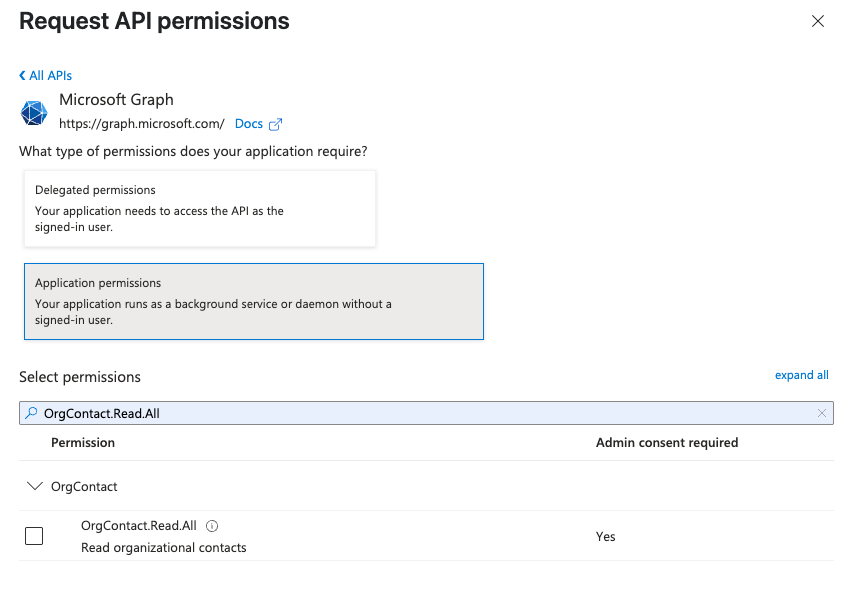
NOTE: When setting up an enterprise application in Microsoft Azure, one of the following Microsoft Graph permissions must be granted to enable contact synchronization:
OrgContact.Read.AllDirectory.Read.AllDirectory.ReadWrite.AllThese should be added as Application permissions (not Delegated) in the Azure Portal under your work account. You can find them under the Microsoft Graph category in the API permissions section of the app.
¶ Custom Contacts Settings
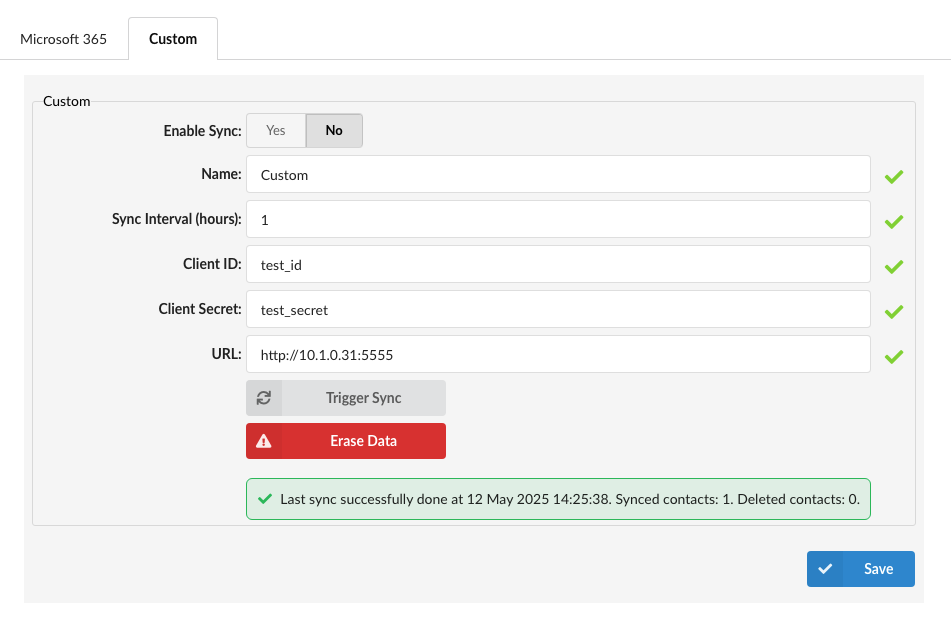
The Custom tab allows integration with a third-party or self-hosted contact management service. Administrators can define the connection details for syncing:
-
Enable Sync: This toggle controls whether automatic synchronization with the external contact source is active.
-
If set to No, the configuration will be saved, but no synchronization will occur regardless of the value set in Sync Interval (hours). In this case, contacts will not be synced until the user manually triggers the sync by clicking the Trigger Sync button.
-
If set to Yes from the beginning, the system will immediately perform a full synchronization of all contacts from the external source, and continue to sync them periodically based on the interval defined in Sync Interval (hours).
-
The default value for Sync Interval is 24 hours, meaning the sync will run once every 24 hours unless changed by the administrator.
-
After the initial full sync, all subsequent sync operations will only process newly added, edited, or deleted contacts, ensuring efficient updates without reimporting all data.
This setting gives users control over whether syncing begins immediately or remains inactive until explicitly triggered.
-
-
Name: Label or identifier for the custom source.
-
Sync Interval (hours): Time interval for periodic automatic syncs.
-
Client ID / Client Secret: Credentials used to authenticate with the custom contact service.
-
URL: Endpoint of the custom contact server (e.g.,
https://example.com:5555). -
Trigger Sync: Immediately starts a manual synchronization process with the external contact source. Upon clicking, users are prompted with a confirmation dialog:
"This action will trigger sync immediately. Are you sure you want to continue with this action?"-
If this is the first time the sync is being triggered (i.e., no previous sync has occurred), the system will perform a full synchronization, importing all available contacts from the external source.
-
On subsequent uses, only newly added, edited, or deleted contacts will be processed and synchronized, minimizing load and ensuring the contact list stays up to date.
This option is useful for performing an immediate update outside of the regular sync interval or after adjusting configuration settings.
-
-
Erase Data: Removes the source configuration and deletes all contact data retrieved from the custom source. This includes any associated activities. A confirmation prompt is shown:
"This action will delete all data related to this custom contact source, including contacts and activities related to those contacts. Are you sure you want to continue with this action?" -
Status Message: Displays information about the last sync operation, including date, time, and number of synced/deleted contacts.
📘 Custom Contacts Integrator Example
Bicom Systems provides an example application for integrating third-party contact sources into PBXware. The repository is available at:
🔗 Custom Contacts Integrator on GitHub
This repository includes:
- A sample implementation of a custom contact source integrator.
- A PDF guide detailing how to connect the application to PBXware.
The documentation covers setup instructions, configuration steps, and usage guidelines to facilitate seamless integration.
¶ Central Phone Book
NOTE
The Central Phone Book has been deprecated starting from PBXware version 8.All contact management is now handled exclusively through the Contacts Module.
Global, Department, and Private contacts are centrally managed via the Contacts interface in PBXware and gloCOM applications.